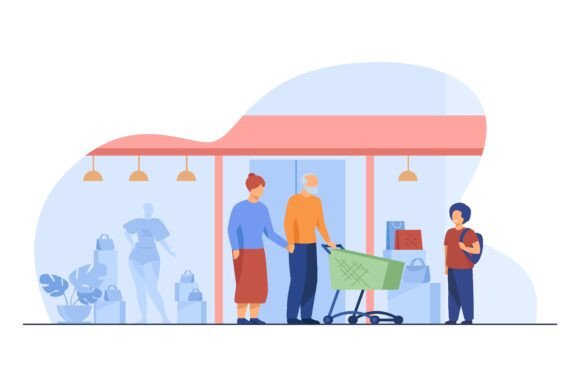
Senior Couple and Kid Shopping in Mall: A Visual Narrative for Modern Design
In an era where digital interactions often feel transactional and fleeting, there is a profound hunger for imagery that speaks to enduring human connections. The concept of a Senior Couple and Kid Shopping in Mall captures more than just a commercial activity; it encapsulates a moment of intergenerational bonding that resonates deeply with audiences across the globe. This specific visual narrative, often rendered as a meticulously crafted vector illustration, serves as a powerful tool for designers, marketers, and business owners looking to infuse their digital spaces with warmth, authenticity, and relatability.
When we examine the scene—a little boy walking alongside his grandparents, perhaps pushing a shopping cart or peering into a store window—we see a microcosm of family life that transcends cultural boundaries. It is a depiction of guidance, patience, and shared discovery. For professionals creating banners, website designs, or web page landing sights, this artwork offers a unique opportunity to blend modern lifestyle aesthetics with timeless values. It moves beyond the sterile perfection of stock photography to offer a stylized, emotionally intelligent representation of commerce and care.
The Emotional Resonance of Intergenerational Commerce
Why does this specific scenario hold such weight in contemporary design? The answer lies in the shifting dynamics of family structures and consumer behavior. As society evolves, the role of grandparents in child-rearing has become increasingly prominent. In many households, grandparents are not just occasional visitors but active participants in daily routines, including the quintessential shopping experience. The image of a Senior Couple and Kid Shopping in Mall reflects this reality, validating the experiences of millions of families who rely on extended kin networks for support and companionship.
From a psychological perspective, this imagery triggers positive associations. It evokes feelings of safety, nostalgia, and trust. When a user lands on a webpage featuring this type of illustration, they are subconsciously signaling that the brand values community and long-term relationships over quick sales. This is particularly effective for businesses in sectors like retail, insurance, healthcare, and education, where trust is the currency of engagement. The flat vector style enhances this by stripping away unnecessary details, allowing the viewer to focus entirely on the emotional core of the interaction: the bond between generations.
Reflecting Changing Family Dynamics
The relevance of this theme extends beyond simple sentimentality. It mirrors a tangible shift in how families operate. With dual-income households becoming the norm, grandparents often step in to manage errands and accompany children to stores. This practical reality makes the scene highly relatable. Unlike images depicting nuclear families alone, which can feel exclusive to some viewers, the inclusion of seniors broadens the appeal. It acknowledges the multi-generational nature of modern life.
Furthermore, the setting of the mall itself has evolved. While e-commerce dominates headlines, physical retail spaces have transformed into social hubs. Families visit malls not just to buy goods but to spend time together. The illustration captures this duality perfectly. The shopping cart represents the commercial aspect, while the body language of the trio—the way they stand close, perhaps pointing at something in a store window—highlights the social and emotional dimensions of the outing. This balance is crucial for brands trying to position themselves as part of the customer's lifestyle rather than just a vendor.
Design Trends and the Rise of Flat Vector Art
The choice to render this scene as a flat vector marvel is not arbitrary; it aligns with current trends in digital design. Over the past decade, there has been a marked move away from hyper-realistic imagery toward clean, geometric, and colorful vector art. This shift is driven by several factors, including the need for faster load times on mobile devices, scalability across various screen sizes, and a desire for a more approachable, friendly aesthetic.
A flat vector illustration of a Senior Couple and Kid Shopping in Mall offers distinct advantages for web designers. First, it is infinitely scalable. Whether the image is used as a tiny icon on a mobile app or a massive hero banner on a desktop site, the lines remain crisp and the colors vibrant. Second, vectors are lightweight, contributing to better site performance scores, a critical factor for SEO and user retention. Third, the stylized nature of vector art allows for creative flexibility. Designers can easily adjust color palettes to match brand guidelines without compromising the integrity of the image.
Integrating Elements for Maximum Impact
Effective use of this artwork requires attention to the specific elements within the composition. The shopping cart, for instance, acts as a focal point that anchors the scene in a commercial context. However, it should not overpower the human element. The store window provides depth and suggests the broader environment, inviting the viewer to imagine what might be inside. These details create a sense of place without cluttering the design.
For creators, the challenge lies in ensuring the illustration feels authentic. The characters should not look like generic placeholders. The senior couple should exhibit dignity and warmth, while the child should appear curious and engaged. When these nuances are captured correctly, the result is a compelling concept that revolutionizes digital designs by making them feel more human. It transforms a standard landing page into a storytelling platform that invites users to linger and connect.
Practical Applications for Businesses and Creators
How can professionals leverage this visual narrative in their work? The applications are diverse and extend across multiple industries. For e-commerce platforms, using this imagery on homepage banners can signal a commitment to family-friendly policies or services. It suggests that the platform understands the needs of multi-generational shoppers. Financial institutions might use it to illustrate themes of legacy, savings for grandchildren, or retirement planning, grounding abstract financial concepts in real-life scenarios.
Marketing campaigns focused on holidays or seasonal sales can also benefit immensely. Instead of relying on clichéd imagery of crowded aisles or stressed shoppers, a serene depiction of a grandparent and grandchild enjoying a shopping trip conveys a message of joy and relaxation. This positive framing can differentiate a brand in a saturated market. Bloggers and educators can use the illustration to introduce articles about parenting, aging gracefully, or the importance of family traditions, providing a visual hook that draws readers in.
Enhancing User Experience and Engagement
Beyond marketing, this type of imagery plays a role in user experience (UX) design. Websites that incorporate warm, relatable visuals tend to have higher engagement rates. Users are more likely to trust a site that feels welcoming. The Senior Couple and Kid Shopping in Mall illustration serves as a visual cue that the brand is safe, inclusive, and community-oriented. It reduces the cognitive load on the user by instantly communicating the brand's values without the need for extensive text.
Moreover, in the realm of content strategy, this visual can act as a versatile asset. It can be animated for social media stories, used as a background for video testimonials, or broken down into individual elements for infographic design. Its adaptability makes it a cost-effective investment for businesses looking to refresh their visual identity. By integrating such thoughtful artwork, companies demonstrate an understanding of their audience's emotional landscape, fostering a deeper connection that goes beyond the transactional.
Navigating the Future of Digital Storytelling
As we look toward the future of digital design, the demand for authentic, human-centric content will only grow. Audiences are becoming increasingly adept at spotting synthetic or overly polished content that lacks soul. They crave narratives that reflect their own lives and struggles. The story of a Senior Couple and Kid Shopping in Mall is one such narrative. It is grounded, realistic, and universally understood.
The evolution of this trend suggests a move towards more nuanced representations of family. We are moving away from the idealized, perfect family portraits of the past toward images that celebrate diversity, age, and the everyday moments that define our lives. This illustration fits perfectly into that paradigm. It acknowledges that shopping is not just about consumption; it is about connection. It is about passing down knowledge, sharing laughter, and creating memories.
For entrepreneurs and freelancers, staying ahead of this curve means prioritizing quality and emotional intelligence in their visual assets. It means choosing illustrations that tell a story rather than just fill space. By selecting artwork that seamlessly blends modern lifestyle with enduring family values, creators can etch out a compelling concept that resonates with users on a fundamental level. In a digital world that often feels cold and disconnected, such warmth is not just a nice-to-have; it is a necessity.
Ultimately, the power of this visual lies in its ability to bridge gaps. It bridges the gap between generations, between commerce and community, and between the digital screen and the human heart. Whether used for a corporate website, a personal blog, or a marketing campaign, the Senior Couple and Kid Shopping in Mall illustration stands as a testament to the enduring power of familial bonds. It reminds us that even in the most routine activities, there is magic to be found if we take the time to look. For designers and businesses willing to embrace this perspective, the rewards are clear: stronger engagement, deeper trust, and a more meaningful connection with their audience.